
Make the claim.
Show the check.
Business questions, simulated datasets, checked outputs and a written explanation. Practice the reasoning that sits between a tool and a useful decision.
Start the free retail investigation →Sales rose.
What can you actually conclude?
A simulated retail manager asks whether higher order value and a lower observed delivery time mean performance improved. Audit the raw orders, reconcile the two months and challenge the headline.
- Existing Northstar data: raw and verified order files
- Local SQL tasks and an interactive dashboard reference
- Online numeric verification with explained feedback
- Decision memo, reproducibility checklist and self-review rubric
No costs are supplied, so this assignment cannot establish profitability. No customer records or real client data are used.
Open the assignment and practice kit →From request to evidence
- QuestionDefine the decision and metric grain
- InspectPreserve raw exceptions and verify keys
- AnalyzeReconcile totals, shares and coverage
- ExplainReport uncertainty and next evidence
The arrows describe dependencies, not automatic approval of the result.
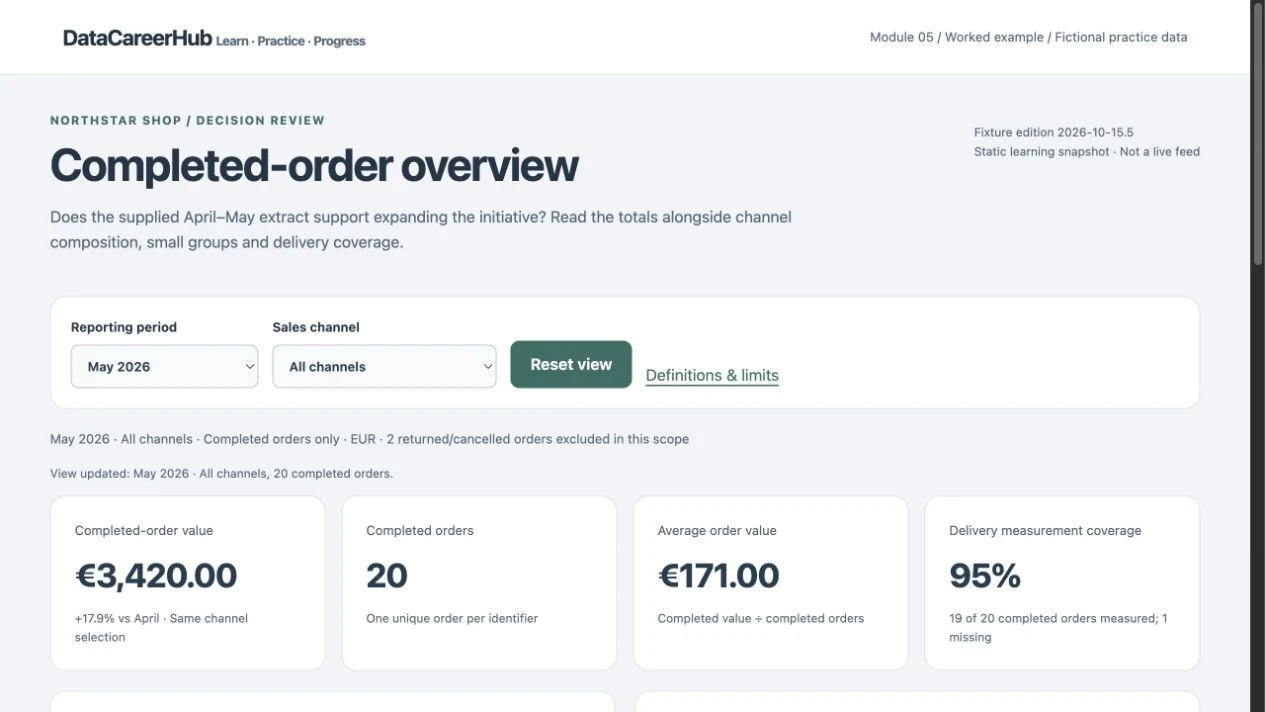
A useful result includes its definition.
The same completed-order population drives the totals and channel comparisons. Coverage tells you which delivery observations are missing.
This is a reference to compare with your own work. It is not an automatic assessment of your dashboard, and it does not report real client performance.
Read the metric contract →Continue in the existing practice system
- SQL Investigation
- Completed-order challenge and the free retail investigation above.
- Data Cleaning
- Investigate repeated and conflicting records. Free self-practice.
- Dashboard practice
- Specify a decision-focused dashboard. Free self-practice.
- Python automation
- Validate an input contract. Free companion exercise.
- AI evaluation
- Evaluate retrieval and unsupported questions. Local companion exercise.
- Industry analytics
- Fictional retail case and construction dashboard demonstration. Demonstrations are not client engagements.
- Protected projects and ML
- Existing Project Lab is free with verified email, subject to publication and prerequisites.
Build something you can explain.
Advanced practice uses existing published courses and current permissions. These are learning tools, not a new paid plan.
- Advanced project library
- 7 published extension assignments connect to original datasets, executable local references and rubrics. Explore the current project library → Permitted learners can prepare a downloadable portfolio self-review worksheet; no instructor review is implied.
- Controlled AI evaluation
- Inspect six fixed source-support and action-boundary cases, then challenge the module’s local reference. Open with current module access →
- Private learning-evidence report
- Existing learners can review their own evidence →. Recorded lessons and bounded scores remain separate from work needing human judgment. No job-readiness rating or certification is produced.
Build a method you can explain.
Frame the question, inspect the source, check the calculations and document the limits. Use the worked examples to challenge your approach, then apply the same method to a different scenario.
Clear access. Honest feedback.
The free investigation and companion exercises require no registration. Existing members retain their course access and saved lesson progress. Opening a companion exercise does not complete a course lesson.
Explore practical lessons, worked examples and projects. Follow a published path, practise the method and build work you can explain. Practice feedback does not award a recognized qualification.
Existing permitted learners can save investigation drafts, submit analytical evidence, review numeric feedback and record a rubric-based self-review against the existing portfolio lesson. SQL and subjective reasoning are not automatically graded.
Open the member evidence workspace →Make the claim. Show the check.
Revisit the result.
Learn through original fictional scenarios where the difficult part is deciding what the evidence actually supports. Work at the right grain, expose missing observations and compare your calculation with an explained reference. Keep your reasoning as it develops.
Our Evidence Fieldbook connects small source tables, a decision and a changed-input question. Saved practice requires a verified account and published case availability. It does not automatically complete a lesson or certify competence.
Explore the Evidence Fieldbook with your account →Five years of growing your data skills.
Year 1 starts whenever you begin. Move at your own pace, enter at the level that fits your experience, and revisit skills as your goals change. These stages guide your learning; they are not calendar deadlines or predictions.
- Year 1
Measure what matters
Build sound SQL, spreadsheet and statistical habits. Define a metric, trace its population and explain a check. Start here now if these foundations would help.
- Year 2
Make the work repeatable
Turn a one-off analysis into tested transformations, a clear data contract and a report another person can reproduce.
- Year 3
Reason about an uncertain future
Compare forecasts and predictive models with simple baselines. Keep time, labels, evaluation cutoffs and uncertainty visible.
- Year 4
Keep AI accountable to evidence
Inspect individual claims, source permission and tool boundaries. Practise abstention, human review and measured evaluation.
- Year 5
Build knowledge that can be maintained
Connect analysis, operations and communication. Preserve versions, monitor change, test recovery and share a defensible portfolio.
Find a starting point → · Explore the skills outlook and its sources →